- 516-505-2300
- 718-368-2800
- Available 24/7


Sharifov & Associates, PLLC
Attorneys & Counselors At Law
Grand Jury in New York: Your Rights & Testifying
October 6, 2026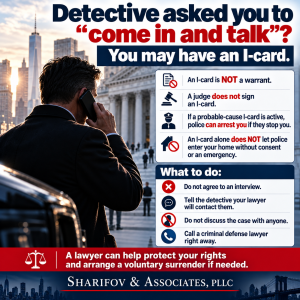
Your phone rings. It’s a detective. He’s polite and says he just wants you to “come down to the precinct and clear something up.” Many people in New York City get a call like this, and many of them walk into the precinct without a lawyer and walk out in handcuffs.
Often, the reason for the call is an I-card. This article explains what an I-card is, how it differs from a warrant, and what you should do if a detective is looking for you.
Key takeaways:
- An I-card is an internal NYPD alert. It is not a warrant and is not signed by a judge.
- If an I-card says police have probable cause, officers who stop you can arrest you.
- An I-card does not allow police to enter your home to arrest you without your consent or an emergency.
- A friendly call to “come in and talk” often means an arrest is already planned.
- Speak with a criminal defense lawyer before you talk to the detective or go to the precinct.
What Is an I-Card?
An I-card, short for Investigation Card, is an alert that an NYPD detective enters into the police computer system when someone is wanted in connection with an investigation. Any officer who checks your name, for example during a traffic stop, can see it. I-cards are governed by the NYPD’s internal procedures, set out in the NYPD Patrol Guide.
An I-card is created by the police. No judge reviews or approves it. There are generally three types:
| Type of I-card | What it means |
|---|---|
| Probable cause to arrest | The detective believes there is enough evidence to arrest you. Officers who stop you may arrest you. |
| Suspect only, no probable cause | Police want to question you, but believe they do not yet have enough evidence to arrest you. |
| Witness | Police believe you may have information about a crime. |
I-cards are not court records, so you cannot look one up yourself. Most people only find out about an I-card when a detective calls them, visits their home or job, or when they are stopped by police.
I-Card vs. Warrant: What Is the Difference?
| I-card | Arrest warrant | |
|---|---|---|
| Who creates it | A police detective | A judge |
| Reviewed by a judge? | No | Yes |
| Charges already filed in court? | No | Usually yes |
| Can police arrest you in public? | Yes, if it is a probable-cause I-card | Yes |
| Can police enter your home to arrest you? | No, unless you consent or there is an emergency | Generally yes, your own home |
| Appears in court records? | No | Yes |
The most important difference is your home. Without a warrant, police generally cannot come into your home to arrest you unless you let them in or there is an emergency. This rule comes from a U.S. Supreme Court decision on home arrests and New York’s rules for executing arrest warrants. That is one reason detectives often call and ask you to come to them.
Why a Detective Asks You to “Come In”
Detectives often call or leave a business card at your home with a message to contact them. They may say:
- “We just want to hear your side of the story.”
- “It’s nothing serious, we just need to clear something up.”
- “If you come in, this will be easier for you.”
The call may sound friendly, but keep in mind:
- You may already be facing arrest. If there is a probable-cause I-card, you will likely be arrested once you arrive.
- Anything you say can be used against you. Detectives are trained to ask questions that help build their case. Even innocent explanations can be misunderstood or used to fill gaps in the evidence.
- You do not have to talk to the police. You have the right to remain silent and the right to a lawyer.
What to Do If a Detective Contacts You
Do:
- Stay calm and polite.
- Write down the detective’s name, precinct or squad, and phone number.
- Say: “My lawyer will contact you.”
- Call a criminal defense lawyer right away.
Don’t:
- Don’t ignore the situation. Ignoring the call does not make the I-card go away, and you could be arrested unexpectedly at home, at work, or during a traffic stop.
- Don’t go to the precinct alone or agree to an interview.
- Don’t explain your side over the phone.
- Don’t discuss the case with friends, family, or the other people involved, or post about it on social media.
- Don’t contact the person who made the complaint. That could lead to new charges.
Learn more: Know your rights when stopped by police (NYCLU)
How a Lawyer Can Help
Calling a lawyer as soon as a detective contacts you can make a real difference:
- Find out why you are wanted. Your lawyer can contact the detective to learn what the investigation is about and whether an arrest is planned.
- Protect you from making statements. Your lawyer speaks for you, so nothing you say can be used against you.
- Arrange a voluntary surrender, if needed. Instead of being arrested at home or at work, you can turn yourself in at a planned time with your lawyer present. This can show the court that you take the case seriously.
- Prepare for arraignment. Your lawyer can gather information in advance that may help the judge decide on release, such as proof of your job, family, and community ties.
- Sometimes, prevent charges. In some cases, a lawyer can provide information that shows there is no basis for an arrest.
Can an Arrest Based on an NYPD I-Card Be Challenged?
Yes. An arrest is lawful only if police had probable cause: enough reliable facts to believe a crime was committed and that you committed it (CPL § 140.10). An I-card alone does not prove that. In court, prosecutors must show that the arresting officers actually had probable cause, or reliable information about a probable-cause I-card, at the time of the arrest. In 2026, New York’s highest court ruled that a defendant’s statements had to be suppressed because prosecutors failed to prove the arresting officers actually relied on a probable-cause I-card.
If the arrest was unlawful, your lawyer can ask the court to throw out evidence that came from it, such as statements, identifications, and items seized.
What About Nassau and Suffolk Counties?
“I-card” is an NYPD term. Police departments on Long Island and elsewhere have their own ways of flagging people they want to question or arrest, but the same rules apply: an internal police alert is not a court warrant, and a detective’s request to “come in” is a reason to call a lawyer first.
Frequently Asked Questions
How do I find out if I have an I-card? You cannot search for one yourself, because I-cards are internal police records. A criminal defense lawyer can contact the detective on your behalf to find out whether you are wanted and why.
Do I have to go to the precinct if a detective asks me to? No. A request to “come in” is not a court order. But ignoring it can lead to an unexpected arrest, so speak with a lawyer right away about the best next step.
Can police arrest me at work on an I-card? If the I-card says there is probable cause, police can arrest you in public places, which can include your workplace. A lawyer can often arrange a voluntary surrender to avoid that.
Can the police come into my home to arrest me on an I-card? Generally, no. Without a warrant, police need your consent or an emergency to enter your home to arrest you. You do not have to let them in, but stay calm and never physically resist, because that can lead to a separate resisting arrest charge.
Will turning myself in help my case? Often it does. A planned surrender with your lawyer shows responsibility and can help when the judge decides on release at arraignment. Your lawyer should still make the arrangements; do not go in alone.
If I explain my side, will the detective drop the case? It is unlikely. By the time a detective calls, police often have already made up their minds. Your explanation is more likely to be used as evidence than to end the case.
Talk to a Lawyer Before You Talk to the Police
If a detective has called you, left a card at your home, or asked you to come in, contact a criminal defense lawyer before you respond. Sharifov & Associates, PLLC represents people under investigation in New York City, on Long Island, and in federal court. Our attorneys include former prosecutors who know how police investigations work.
Call NYC: 718-368-2800 · Long Island: 516-505-2300
This article is general information, not legal advice. Prior results do not guarantee a similar outcome.