- 516-505-2300
- 718-368-2800
- Available 24/7


Sharifov & Associates, PLLC
Attorneys & Counselors At Law
Healthcare Fraud Conspiracy Charges in New York: What You Need to Know
April 11, 2026Arrested for Assault in New York: What to Expect and How to Defend the Charge
May 22, 2026Fake License Plates in New York: Criminal Charges, Penalties, and What to Do If You Were Arrested
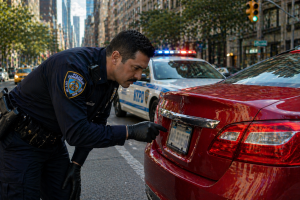
Fake and forged motor vehicle license plates have become an increasingly common basis for criminal arrest in New York. What many people do not realize when they put a set of fake temporary plates on their car is that they are not just risking a traffic ticket — they are risking a criminal charge, a permanent criminal record, and in some cases a felony indictment. If you or someone you know has been arrested in connection with fake or forged license plates, this article will explain the charges, the penalties, how these situations typically arise, and what defenses may be available.
The Criminal Charge: Criminal Possession of a Forged Instrument
In New York, the criminal charge that arises from possession of fake license plates falls under Article 170 of the New York Penal Law, which governs forgery and related offenses. There are three degrees of Criminal Possession of a Forged Instrument. In fake license plate cases, prosecutors most commonly charge one of two:
Criminal Possession of a Forged Instrument in the Third Degree — New York Penal Law § 170.20 — is a Class A misdemeanor, punishable by up to 364 days in jail, up to 3 years of probation, and fines. This is a crime, and a conviction creates a permanent criminal record that cannot be expunged.
Criminal Possession of a Forged Instrument in the Second Degree — New York Penal Law § 170.25 — is a Class D felony, punishable by up to 7 years in state prison. For a first-time offender, a judge has discretion to impose a lesser sentence — including probation, a conditional discharge, fines, or a shorter jail term — but the felony conviction itself and its permanent consequences remain if the case is not successfully defended or resolved.
The key difference between the two charges in a license plate case is the nature of the instrument. License plates and motor vehicle registrations are issued by a government agency — in New York, by the Department of Motor Vehicles. Under PL § 170.10(3), written instruments “officially issued or created by a public office, public servant or governmental instrumentality” fall into the category that triggers the felony charge under PL § 170.25. This is why what might seem like a minor traffic matter can become a felony criminal case.
To be found guilty under either statute, the prosecution must prove three elements beyond a reasonable doubt: that the instrument was in fact forged, that you knew it was forged, and that you possessed or used it with intent to defraud, deceive, or injure another person. Knowledge and intent are the critical elements — and they are also where the most important defenses arise.
How These Cases Typically Happen
The most common scenario we see in our practice follows a predictable pattern. Someone buys a used car — from a private seller or a used car dealer — and instead of obtaining legitimate license plates from the DMV or valid 30-day temporary dealer plates, they purchase fake dealer plates or fake out-of-state temporary plates online, through Craigslist, or from an unlicensed individual or storefront. Sometimes people do this once, intending it as a short-term solution while they sort out registration or insurance. Others repeat the process month after month, purchasing new fake temporary plates as the old ones expire. This repeated conduct is particularly damaging legally — it strongly suggests knowledge that the plates were not legitimate, since no reasonable person buys official government-issued plates from an anonymous online seller every 30 days.
The most common reasons we hear for why someone went this route include:
Not having a valid driver’s license. Operating a vehicle without a license makes legitimate DMV registration more complicated, so some people turn to fake plates to avoid scrutiny. Not having valid auto insurance. Registering a vehicle with the DMV requires proof of insurance. Someone who wants to drive without insuring the vehicle may use fake plates to avoid that requirement. Wanting to avoid traffic cameras or toll detection. Fake plates — especially out-of-state plates — may be used to avoid automated systems that scan and record plates. These situations are understandable. But they make the underlying criminal charge significantly harder to defend, because they give the prosecution evidence of both knowledge and intent. If you are driving without a license, without insurance, and with fake plates, a prosecutor will argue the motive is obvious — and that argument is a strong one.
Additional Charges That Come With Fake Plate Arrests
Fake license plate arrests rarely result in just one charge. In most cases we handle, clients face several charges arising from the same traffic stop:
Criminal Possession of a Forged Instrument (PL § 170.20 or § 170.25) — the primary charge related to the plates.
Aggravated Unlicensed Operation (VTL § 511) — if the driver does not have a valid license, this is a separate criminal charge ranging from an unclassified misdemeanor to a Class E felony depending on the number and type of suspensions.
Driving Without Insurance (VTL § 319) — a traffic infraction carrying fines, license suspension, and civil consequences.
Unlicensed Operation of a Motor Vehicle (VTL § 509) — a separate charge for operating without a valid license.
Forgery charges under PL §§ 170.05 or 170.10 may also be added if there is evidence the person was involved in creating or altering the plates, not merely possessing them.
This combination of charges can make what seems like a minor situation into a complex multi-charge criminal case. Having an attorney who can address all charges together and negotiate a global resolution is essential.
How Police Detect Fake Plates
Police routinely discover fake plates through automated license plate reader technology — scanners mounted on patrol cars or fixed at intersections that instantly flag plates that do not match valid DMV records. When a plate returns as unregistered, expired, or from a state with no matching record, the officer is alerted and will stop the vehicle. Once stopped with fake plates, a driver will typically be arrested on the spot. In New York City, this often means being taken to central booking and held for arraignment within 24 hours. In Nassau and Suffolk Counties and other suburban jurisdictions, a Desk Appearance Ticket may be issued instead, requiring the driver to appear in court at a later date. Either way, the arrest is processed and fingerprints are taken — creating a permanent arrest record.
The “I Didn’t Know They Were Fake” Defense
The most common thing we hear from clients in these cases is: “I bought them online and was told they were real,” or “I thought they were legitimate temporary dealer plates.”
This defense has real legal merit in some cases — and essentially no merit in others. Under PL §§ 170.20 and 170.25, the prosecution must prove that you knew the instrument was forged. If you genuinely did not know the plates were fake, that is a defense. The problem is that knowledge is almost never proven by a direct admission — it is inferred from the circumstances. And the circumstances in most fake plate cases make it very difficult to argue genuine ignorance:
Only the state DMV or a licensed dealer can issue valid license plates or temporary registrations. Legitimate temporary dealer plates come from licensed dealerships, not from Craigslist, not from strangers, and not from unlicensed storefronts. A person who buys the same fake plate month after month cannot credibly claim they believed each one was legitimate. A person who has no license and no insurance has an obvious motive for using fake plates, which directly undermines any claim of innocent mistake.
That said, genuine defenses do exist. If the driver was not the owner of the vehicle and had no knowledge of the plates, that is a strong defense. If the driver was a first-time used car buyer who was deceived by a fraudulent seller, and there is documentation to support that story, it can be a meaningful defense or significant mitigation. In these situations, we immediately request all documents related to the vehicle purchase: the bill of sale, any written or electronic communications with the seller, any receipts for the plates, and any representations made about the registration or temporary plates.
Collateral Consequences Beyond the Criminal Case
A conviction for Criminal Possession of a Forged Instrument — even at the misdemeanor level under PL § 170.20 — creates a permanent criminal record. It will not be expunged on a later date simply because it is a misdemeanor rather than a felony. The consequences can include:
Employment. A criminal record for a fraud or forgery offense can disqualify you from jobs requiring background checks, particularly in finance, healthcare, education, government, and licensed professions.
Professional licenses. Conviction can trigger suspension or revocation of healthcare licenses, real estate licenses, financial industry registrations, and other occupational licenses.
Immigration. Criminal Possession of a Forged Instrument is a fraud-based offense widely classified as a Crime Involving Moral Turpitude (CIMT) under federal immigration law. For non-citizens — including green card holders — a conviction can lead to deportation, inadmissibility, or denial of immigration benefits. This applies at both the misdemeanor and felony level. A felony conviction under PL § 170.25 carries all of these consequences plus the full weight of a permanent felony record, including restrictions on certain civil rights and far greater barriers to employment, housing, and licensing.
How These Cases Are Typically Resolved
The good news for most clients is that a fake license plate charge can frequently be resolved without a criminal conviction — particularly for first-time offenders. Factors favoring a favorable resolution include having no prior criminal record, and especially no prior history of forgery or possession of forged instrument convictions. The more documentation exists showing the person was deceived about the plates, the stronger the mitigation. Cooperation with the process and early retention of counsel also help. Factors making resolution more difficult include evidence of repeated conduct — buying fake plates month after month — the presence of additional charges like unlicensed operation and no insurance, any prior criminal history, and any statements made to police before consulting an attorney. Possible dispositions range from outright dismissal, to an Adjournment in Contemplation of Dismissal (ACD), to a reduction to a non-criminal violation such as disorderly conduct, to a conditional discharge. For felony charges, a common and important resolution is a negotiated plea to the misdemeanor — avoiding a felony record entirely. Clients who contact us early — before making statements to police or appearing in court without counsel — are in the strongest position to achieve the best possible outcome.
Frequently Asked Questions
Are fake temporary plates always a felony charge?
Not always. Many fake plate cases are charged as misdemeanors under PL § 170.20. Whether police elevate the charge to a felony under PL § 170.25 depends on the specific circumstances, the jurisdiction, and the nature of the plates. Our firm has handled both misdemeanor and felony versions of this charge.
I bought the plates online and thought they were real. Does that help?
It depends on the circumstances and the documentation that exists. If you can show you were deceived — through a bill of sale, communications with the seller, or other evidence — this can be meaningful mitigation or the basis for a defense. An attorney should review the specific facts before any statements are made to police or prosecutors.
I have no prior record. Will I go to jail?
For first-time offenders without a prior record, jail is very unlikely on a fake plate charge — even at the felony level, a judge has discretion to impose probation or a conditional discharge. The more serious concern for most clients is the criminal record itself, which can affect employment, licensing, and immigration status for years. The goal in most first-offense cases is a non-criminal resolution.
What documents should I gather immediately?
Everything related to the vehicle purchase: the bill of sale, any emails or text messages with the seller, any receipts for the plates, any representations made about the registration or temporary plates, and any other documentation that establishes where the plates came from and what you were told about them. Bring all of this to your attorney consultation.
Can this affect my immigration status?
Yes, seriously. Criminal Possession of a Forged Instrument is a fraud offense classified as a Crime Involving Moral Turpitude under federal immigration law. Non-citizens — including lawful permanent residents — should consult with a criminal defense attorney who understands immigration consequences before resolving any case.
Contact Sharifov & Associates, PLLC
If you have been arrested or charged in connection with fake or forged license plates anywhere in New York City or Nassau County, contact us for a prompt confidential consultation. We will review the charges, explain your options, and advise you on the best path forward. We represent clients in Brooklyn, Queens, Manhattan, the Bronx, Staten Island, Nassau County, and Suffolk County.
718-368-2800 (NYC / Brooklyn) 516-505-2300 (Long Island / Nassau County) 1-888-LAW-2407
Available 24/7. Former New York Prosecutor. Rated by Super Lawyers. 23+ years of experience.
Attorney Advertising. This article is for general informational purposes only and does not constitute legal advice or establish an attorney-client relationship. The outcome of any case depends on the specific facts and circumstances involved.