Custody and visitation cases are among the most personal and emotional matters a family can face. Whether you are separating, divorcing, never married, or seeking to change an existing order, the outcome will shape your relationship with your children for years to come.
At Sharifov & Associates, PLLC, we represent parents and family members in custody and visitation cases in Family Courts and Supreme Courts throughout New York City and Long Island, through negotiation and, when necessary, trial.
Key points:
New York decides custody based on the child's best interests, with no preference for mothers or fathers.
There is no automatic presumption of joint custody.
Custody orders can be modified after a change in circumstances.
Effective March 1, 2026, the child support formula applies to combined parental income up to $193,000 (opens in a new tab).
Types of Child Custody in New York
Legal custody: the right to make major decisions about a child's education, medical care, and religion.
Physical (residential) custody: where the child primarily lives.
Joint custody: both parents share decision-making. It works best when parents can communicate and cooperate.
Sole custody: one parent has decision-making authority.
The parent without primary physical custody usually receives parenting time (visitation) (opens in a new tab) under a schedule, from alternating weekends to extensive shared time. When there are safety concerns, the court may order supervised visitation.
How New York Courts Decide Custody: The Best Interests of the Child
New York courts decide custody based on the best interests of the child. There is no automatic preference for mothers or fathers, and no automatic presumption of joint custody. Courts consider factors such as:
which parent has been the primary caretaker;
each parent's ability to provide a stable home and meet the child's needs;
each parent's willingness to support the child's relationship with the other parent;
the child's relationships with siblings and extended family;
the child's wishes, given more weight as the child gets older;
Unmarried fathers. If the parents were not married, paternity may need to be established before a father can seek custody or visitation, for example through a signed Acknowledgment of Paternity (opens in a new tab) or a court order.
The Custody Process Step by Step
Petition and first appearance. The court may issue temporary orders while the case is pending.
Attorney for the Child. The court often appoints a lawyer to represent the child.
Investigations and evaluations. The court may order home studies or a forensic evaluation by a mental health professional.
Settlement or trial. Many cases settle through a negotiated parenting agreement. Otherwise, the judge decides after a hearing.
Preparing your case. Records of your involvement in your child's life, such as school and medical records, communications with the other parent, and a consistent parenting history, can be powerful evidence.
Relocation With a Child
A parent who wants to move a significant distance with a child generally needs the other parent's consent or the court's permission. Courts weigh the reasons for the move, its effect on the child's relationship with the other parent, and whether it would benefit the child.
Modifying or Enforcing a Custody Order
Modification. A custody or visitation order can be changed if there has been a change in circumstances and the change serves the child's best interests.
Enforcement. If a parent doesn't follow an order, the other parent can file a violation petition.
Child Support in New York (2026)
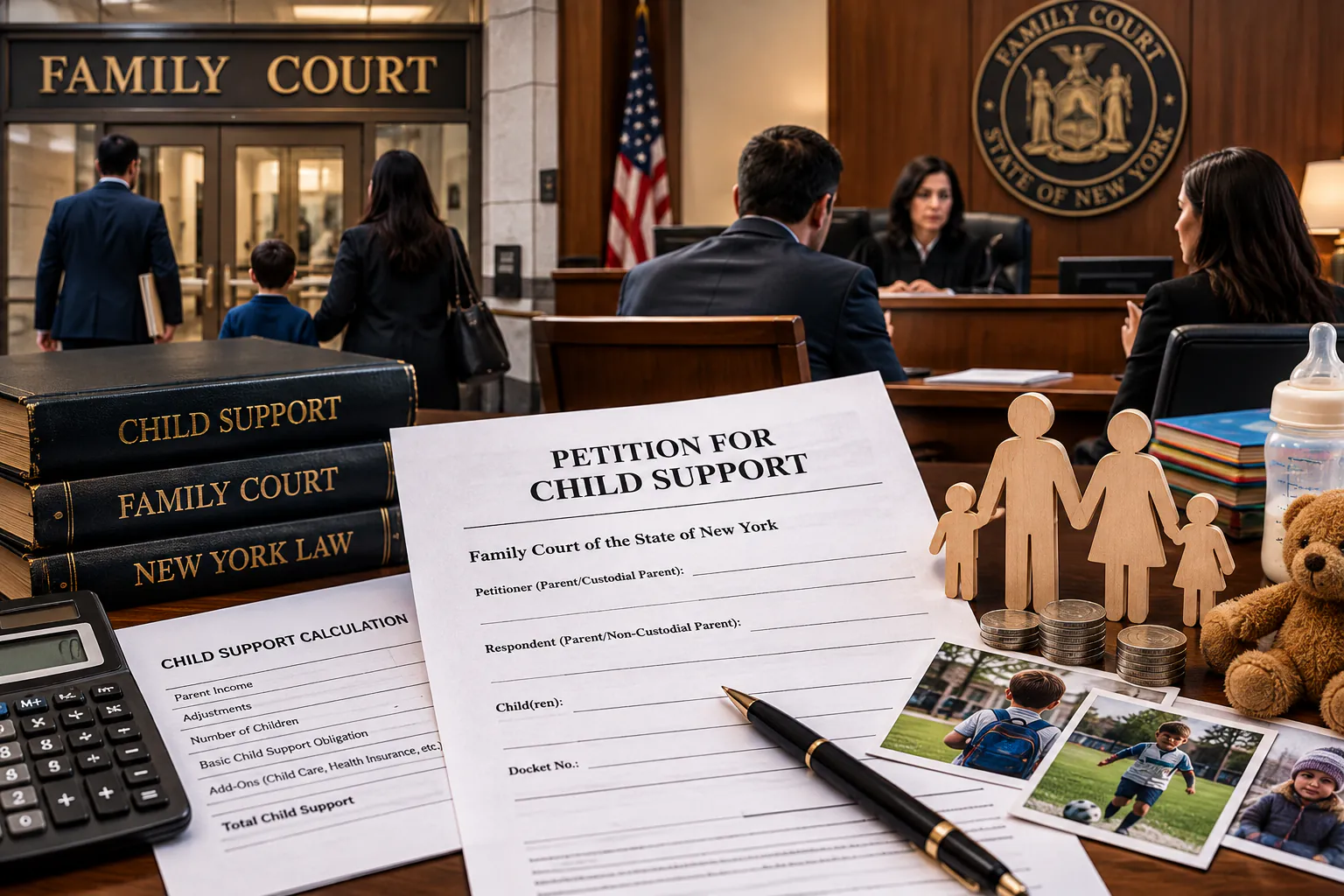
Child support is calculated under the Child Support Standards Act (opens in a new tab), using a percentage of combined parental income: 17% for one child, 25% for two, 29% for three, 31% for four, and at least 35% for five or more. Effective March 1, 2026, the percentages apply to combined parental income up to $193,000 (opens in a new tab). A support order can generally be modified after three years, after a 15% change in either parent's income, or upon a substantial change in circumstances.
Grandparents' Rights and Other Relatives
Grandparents may seek visitation in certain circumstances (DRL § 72). A grandparent or other non-parent can seek custody only after first showing extraordinary circumstances, such as abandonment, persistent neglect, or an extended period during which the non-parent cared for the child.
Special Immigrant Juvenile Status (SIJS). In some custody and guardianship cases, the Family Court can make findings that allow an eligible non-citizen child under 21, who has been abused, neglected, or abandoned by a parent, to apply for SIJS, a path to a green card. Our combined family and immigration practice allows us to handle both parts of these cases.
Why Choose Sharifov & Associates, PLLC
Custody and visitation experience in Family and Supreme Courts across NYC and Long Island
Negotiation and trial experience
Family and immigration experience under one roof, including SIJS matters
Offices in NYC and Long Island
Practical answers
Frequently Asked Questions
Do mothers automatically get custody in New York?
No. Courts decide based on the child's best interests, with no preference for either parent.
At what age can a child choose which parent to live with in New York?
There is no set age. The court considers the child's wishes, giving them more weight as the child matures, but the decision is based on the child's best interests.
Can I move out of state with my child?
Generally only with the other parent's consent or the court's permission.
Can a custody order be changed?
Yes, if there has been a change in circumstances and the change serves the child's best interests.
Can grandparents get visitation in New York?
In some circumstances, yes. Grandparents seeking custody must first show extraordinary circumstances.
A practical overview for parents starting, responding to, enforcing, or seeking to modify child support in New York Family Court, including filing, financial disclosure, hearings, and additional expenses.
Child support orders in New York can sometimes be modified when circumstances change. A parent may lose a job, suffer a reduction in income, become disabled, experience business losses, have a significant change in financial circumstances, or believe that the existing child…
Learn who may seek or face a Family Court Order of Protection, how a family-offense petition proceeds, and how temporary or final orders can affect contact, custody, and housing.
Seeking or facing an order
Confidential consultation
Need Help With Custody or Visitation? Contact Us Now.
Contact Sharifov & Associates, PLLC for a confidential consultation about your custody or visitation matter.


 Family Law


 WhatsApp
 Telegram