
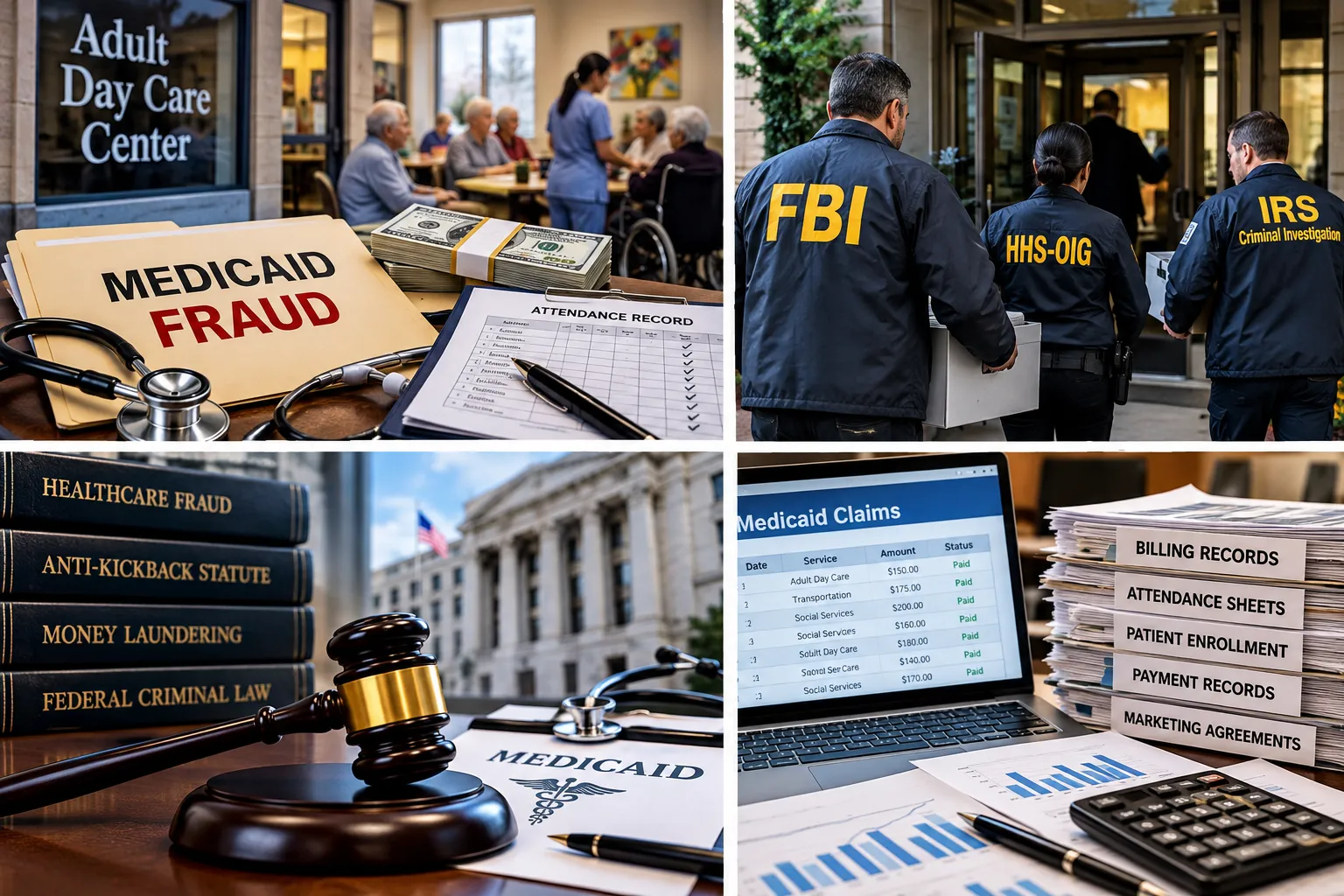
Federal prosecutors in Brooklyn have charged owners, managers, and recruiters connected to social adult day care centers in a series of Medicaid fraud cases, including defendants from Brooklyn and Queens. Common allegations include Medicaid billing for members who did not attend, falsified attendance records, and cash or gifts paid to recruit members. If you own, manage, or work at a center that has received a subpoena, a search warrant, or a call from an FBI or HHS-OIG agent, this guide explains what the government must prove, what charges and penalties are possible, and how a federal Medicaid fraud defense lawyer in New York can help.
| What to expect | |
|---|---|
Who investigates | Federal: FBI, HHS Office of Inspector General (HHS-OIG), Homeland Security Investigations (HSI), and IRS Criminal Investigation. State: the New York Attorney General's Medicaid Fraud Control Unit and the Office of the Medicaid Inspector General (OMIG) |
Common charges | Health care fraud, conspiracy, illegal kickbacks, wire fraud, money laundering |
Maximum prison exposure | Generally up to 10 years for health care fraud or kickbacks, and up to 20 years for wire fraud or money laundering |
Where cases are heard | Brooklyn, Queens, Staten Island, and Long Island: Eastern District of New York (EDNY). Manhattan and the Bronx: Southern District of New York (SDNY) |
Why Adult Day Care Centers Are Being Investigated
When Medicaid pays for social adult day care in New York, it usually does so through a managed long-term care (MLTC) plan, and the center bills the plan for the days a member attends. New York requires plans to check centers' sign-in and sign-out records and to visit their sites. Because payment depends on attendance, investigators focus on whether the attendance records match reality.
Cases often begin with a complaint from a former employee or member, an MLTC plan audit, unusual billing patterns, or information from a separate investigation. An inquiry into one center can expand to related businesses, such as marketers, transportation companies, home care agencies, and pharmacies, and to anyone who handled the money.
Common Allegations
- Billing for absent members: claims for days when members did not attend or did not receive the services billed.
- Falsified attendance records: sign-in sheets, logs, or electronic records created or changed to support the claims.
- Kickbacks to members: cash, gift cards, or other benefits given to members in exchange for enrolling or attending.
- Paid recruiters: per-member payments to recruiters or marketing companies for bringing in Medicaid members.
- Inflated attendance: claims for more members than actually attended, or more than the center's permitted capacity.
- Hidden money flows: payments routed through related companies, cash withdrawals, or third parties.
None of these facts automatically proves a crime. What a person knew and intended is usually the center of the case.
Federal Charges and Maximum Penalties
| Charge | Federal law | Maximum prison term |
|---|---|---|
Health care fraud | 10 years (more if a patient is seriously injured or dies) | |
Health care fraud conspiracy | Same as the underlying fraud | |
Conspiracy to defraud the United States or to pay kickbacks | 5 years | |
Illegal kickbacks | 10 years (fines up to $100,000 per violation) | |
Wire fraud | 20 years | |
Money laundering | 20 years (§ 1956) or 10 years (§ 1957) |
These are maximums, not typical sentences. The actual sentence depends on the charges, the U.S. Sentencing Guidelines, and above all the loss amount the government can prove. A conspiracy charge does not require that a person personally submitted a claim, which is why owners, managers, and recruiters are often charged together. For more on how conspiracy charges work, see our guide to healthcare fraud conspiracy charges in New York. Some large schemes are also charged under the federal RICO law, based on related crimes such as wire fraud or money laundering.
Who Can Be Charged
Federal investigations reach beyond the owner. Prosecutors may look at program directors and managers, billing and administrative staff, recruiters and marketers, bookkeepers, and owners of related businesses.
A job title is not proof of a crime. An employee who entered attendance numbers given by a supervisor may not have known they were false. A marketer who performed real services may have known nothing about the billing. The government must prove what each person knew and did.
How Medicaid Fraud Cases Are Defended
- No intent to defraud. Health care fraud requires knowing and willful conduct. Billing errors, misunderstood program rules, and reliance on others' records are not crimes by themselves.
- The services were provided. Transportation logs, meal and activity records, photographs, and witnesses can show that members actually attended.
- No agreement. Working at the center or knowing the people involved does not prove a person joined a conspiracy.
- Legitimate payments. Not every payment to a marketer, contractor, or employee is a kickback. The Anti-Kickback Statute has exceptions and regulatory safe harbors, including for bona fide employees.
- The loss is overstated. The total billed, the amount paid, and the amount actually fraudulent are often very different. The loss figure drives sentencing, restitution, and forfeiture.
- Unlawfully obtained evidence. Search warrants, device seizures, and interviews can be challenged when they violate the Constitution or federal law.
If Agents Arrive or You Receive a Subpoena
- Do not obstruct a search warrant. Ask for a copy, let agents work, and write down what they take.
- You can decline an interview. You can politely say you want to speak with a lawyer first. Anything you say can be used later, even if you believe you did nothing wrong.
- Never destroy or change records. Deleting messages, altering attendance sheets, or asking others to "fix" documents can lead to separate obstruction charges.
- Do not ignore a grand jury subpoena. A subpoena does not mean you are charged, but it has deadlines, and a lawyer can often negotiate its scope with the prosecutor. See what happens at a grand jury.
- Call a federal defense lawyer early. Early contact with prosecutors can affect whether a person is treated as a witness, a subject, or a target.
If agents or investigators contacted you by phone or at home, our guide on what to do when contacted by law enforcement explains your rights.
Consequences Beyond Prison
- Exclusion from Medicaid and Medicare. A conviction related to a health care program generally leads to mandatory exclusion by HHS-OIG for at least five years, which can end a career in health care.
- Restitution and forfeiture. Courts can order repayment and the forfeiture of money and property, and accounts can be frozen early in the case.
- Licenses and business. Professional licenses, operating certificates, and related companies can be affected.
- Immigration. For non-citizens, a fraud or money laundering conviction can lead to deportation. Learn more about immigration consequences of criminal charges.
Federal Case or State Case?
Not every Medicaid case is federal. The New York Attorney General's Medicaid Fraud Control Unit also brings state criminal charges, the Office of the Medicaid Inspector General audits providers and can seek repayment, and New York City investigators sometimes ask Medicaid recipients to appear for interviews. Our article on Medicaid fraud investigations in New York covers those local interviews. Federal cases from Brooklyn, Queens, Staten Island, Nassau, and Suffolk are filed in the Eastern District of New York; cases from Manhattan and the Bronx are filed in the Southern District of New York.
Practical answers
Adult Day Care Medicaid Fraud FAQ
Can I be charged if I never submitted a Medicaid claim?
Is paying someone to recruit members a crime?
I only followed my employer's instructions. Am I protected?
Can the government freeze my bank accounts?
Should I talk to the FBI if I did nothing wrong?
Which court will hear my case?
Talk to a Federal Medicaid Fraud Defense Lawyer in New York
Sharifov & Associates, PLLC defends owners, managers, employees, and others in federal health care fraud, Medicaid kickback, conspiracy, and money laundering investigations and prosecutions in the Eastern and Southern Districts of New York.
If you received a subpoena or target letter, or federal agents visited your center or your home, contact us before you respond: NYC 718-368-2800 · Long Island 516-505-2300 · Request a consultation
Related: Healthcare fraud conspiracy · Federal white-collar defense · Asset seizure and forfeiture
 WhatsApp


 Telegram