
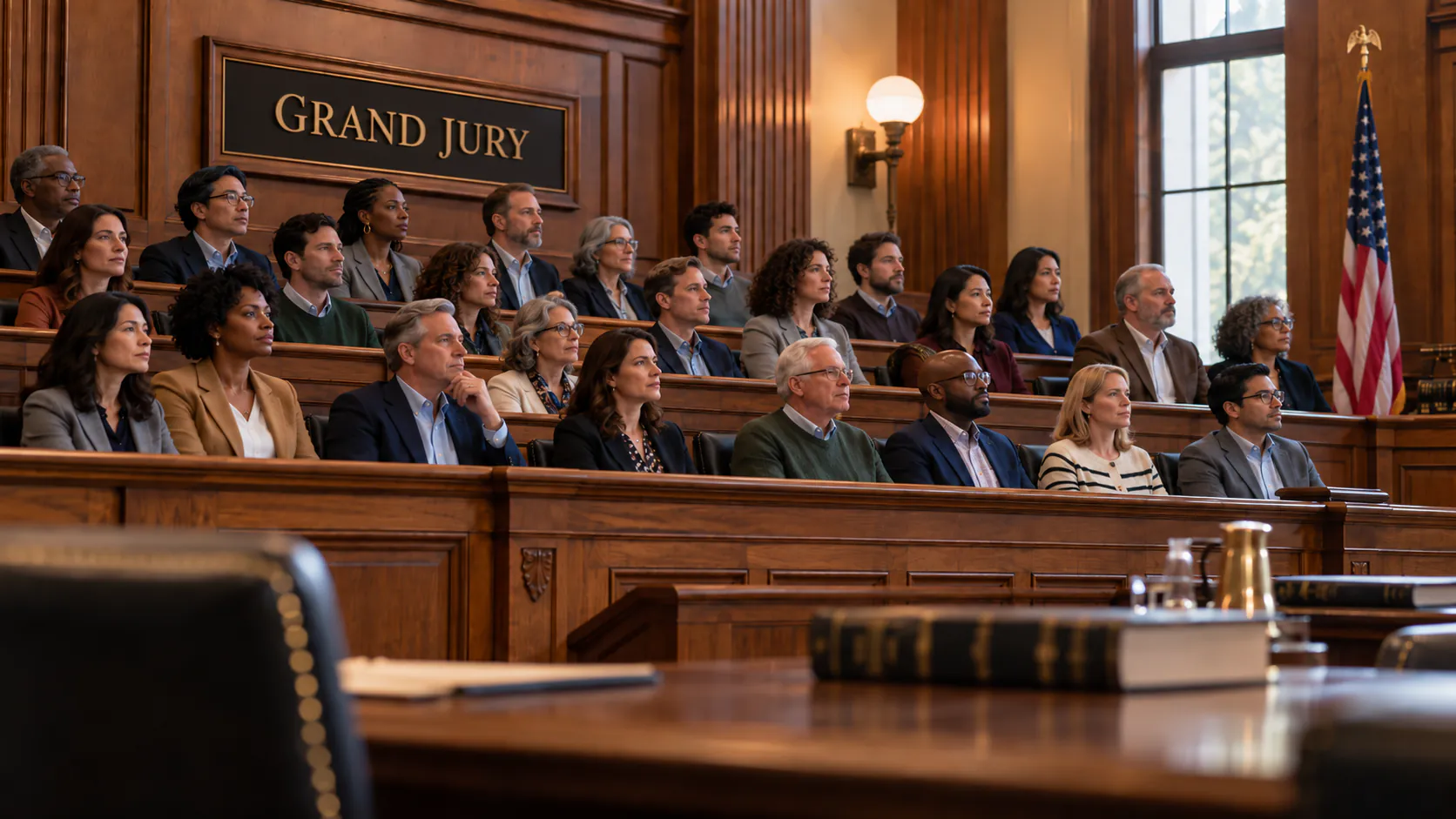
If you or someone you love was arrested for a felony in New York, you may have heard the words "grand jury" for the first time at the first court date. It sounds intimidating, and the process happens behind closed doors, which makes it even more confusing.
This guide explains, in everyday language, what happens at a grand jury in New York, how the process works, and the big decision many people face: whether to go in and tell their side of the story.
The short version:
- A grand jury is a group of ordinary citizens who decide whether there is enough evidence to formally charge someone with a felony.
- It does not decide whether you are guilty.
- You have the right to testify, but only if your lawyer gives written notice in time.
- Testifying can end a case, or it can seriously hurt it. That decision needs a lawyer's advice.
What Is a Grand Jury?
A grand jury is a panel of 16 to 23 regular people from the community. They listen to evidence from the prosecutor and decide one question: is there enough evidence to formally charge this person with a felony?
Think of it as a checkpoint. In New York, a person generally cannot be put on trial for a felony just because the police or a prosecutor says so. A grand jury of citizens has to agree first.
A grand jury is different from the trial jury you see on TV:
| Grand jury | Trial jury | |
|---|---|---|
| Size | 16 to 23 people | 12 people (felony) |
| What it decides | Whether to formally charge you | Whether you are guilty |
| Standard of proof | Reasonable cause to believe you committed the crime | Proof beyond a reasonable doubt |
| Judge in the room? | No | Yes |
| Open to the public? | No, it is secret | Yes |
Can you skip the grand jury? Yes. A defendant can give up the right to a grand jury, with the prosecutor's agreement. This is usually done as part of a plea deal. It is not allowed for the most serious charges, such as murder.
What Happens, Step by Step
- The arrest and first court date. A felony case usually starts with an arrest and a first court appearance, called an arraignment. This happens in NYC Criminal Court or, on Long Island, in District Court. The prosecutor usually announces there that the case will go to a grand jury.
- The clock starts. If you are held in jail, the prosecutor generally has about five days (120 hours from the arrest, or 144 hours if a weekend or holiday falls in between) to get the grand jury to act. Otherwise, you must usually be released. If you are out of jail, the case can take longer.
- The prosecutor presents the evidence. Witnesses such as the alleged victim and police officers testify, and the prosecutor may show documents, video, or other evidence. Grand jurors can ask questions.
- It all happens in secret. No judge is in the room. You and your lawyer are not allowed in while the other witnesses testify, and you cannot hear or read what they said beforehand.
- The vote. At least 12 grand jurors must agree that there is enough evidence to charge you.
The Three Possible Outcomes
1. You are charged ("indictment" or "true bill"). The grand jury votes to charge you with one or more felonies. Your case moves to a higher court: Supreme Court in New York City, or County Court on Long Island. You will be arraigned again on the new charges and the case moves toward hearings, plea talks, or trial.
2. The case is dismissed ("no true bill"). The grand jury decides there is not enough evidence. The charges are thrown out. The prosecutor can try again with a new grand jury only if a judge gives permission.
3. The charges are lowered. The grand jury may charge you with a less serious felony, or decide the evidence supports only a misdemeanor. For example, in an assault case, jurors might not believe a weapon was used. If only a misdemeanor remains, the case goes back to a lower court, where the maximum sentence is 364 days in jail instead of state prison.
Can You Tell Your Side of the Story?
Yes. New York gives people facing felony charges the right to testify in front of the grand jury. The federal system does not give defendants that right.
But there is a catch: you have to claim that right in writing, and in time. Your lawyer must give the prosecutor written notice that you want to testify. This is usually done at your first court date, and it must be served before any indictment is filed. Lawyers call this a "cross-notice."
Once the notice is given, the prosecutor has to tell your lawyer when and where to show up. If the prosecutor ignores a proper notice, the charges can be thrown out. But your lawyer must ask the court for that within five days after you are arraigned on the indictment, or the right is lost.
Not arrested yet? The prosecutor only has to notify people who have already been arraigned on a felony complaint. A case can go to a grand jury before anyone is arrested, without the person being told. If you think you are under investigation, a lawyer can contact the prosecutor and ask for a chance to testify.
You can also ask the grand jury to hear from other witnesses who support your side. The grand jury decides whether to call them.
Should You Testify? The Pros and Cons
This is one of the hardest decisions in a felony case. Testifying can end your case before it starts, but it can also hand the prosecutor exactly what they need.
Why testifying can help:
- If the jurors believe you, they can dismiss the case before it ever reaches trial.
- Your testimony can lead to lower charges, even a misdemeanor.
- The prosecutor does not have to present all the evidence that helps you. Testifying may be the only way the jurors hear your side, such as self-defense.
Why testifying can hurt:
- You must first sign a "waiver of immunity." Normally, a person who testifies before a New York grand jury cannot be prosecuted for what they talk about. Signing the waiver gives up that protection, so you can still be prosecuted and anything you say can be used against you later.
- You testify under oath. A false statement can bring a separate perjury charge.
- The prosecutor and the jurors can question you, and there is no judge in the room to stop unfair questions.
- Your lawyer can be in the room, but only to advise you, not to object or speak to the jurors.
- If you are charged anyway, the prosecutor knows your story before trial, and any change in it can be used to attack your credibility.
In general: testifying tends to help most when your account is consistent, believable, and backed up by other evidence. It tends to hurt most when your story is weak, changes, or would require admitting to other wrongdoing.
How we help clients decide. Clients can tell us everything, because what you tell your lawyer is confidential. When testifying might help, we hold a practice session: one of our attorneys plays the prosecutor and asks the hard questions, while other attorneys judge how believable the answers sound. We recommend testifying only if the client will be a credible, effective witness. The final decision is always the client's.
An Example
This is a made-up example to show how the process works.
Alex is arrested after a fight outside a bar. The other man says Alex hit him with a bottle, so Alex is charged with felony assault. At Alex's first court date, his lawyer serves written notice that Alex wants to testify. The lawyer also finds store video showing the other man threw the first punch, and no bottle anywhere.
After a practice session with his lawyers, Alex testifies and explains he was defending himself. Three things could happen next:
- The jurors believe him and dismiss the case.
- The jurors decide no bottle was used and lower the charge to a misdemeanor.
- The jurors charge him anyway. His testimony is now on record, and the prosecutor can use it to prepare for trial.
That is why the decision to testify is made carefully, case by case.
What to Do If Your Case Is Headed to a Grand Jury
- Talk to a criminal defense lawyer right away. The grand jury stage moves fast, often within days of an arrest.
- Make sure your lawyer protects your right to testify. Written notice should usually be served at the first court date, even if you decide later not to testify.
- Don't discuss the case with police, the alleged victim, friends, or on social media.
- Gather anything that supports your side: texts, photos, receipts, video, and names of witnesses.
- Never decide to testify on your own. Prepare with your lawyer first.
What About Federal Grand Juries?
Federal felony cases also go to a grand jury of 16 to 23 people, and at least 12 must vote to charge. But the rules are tougher for the person under investigation:
- You have no right to testify in a federal grand jury.
- Your lawyer cannot come into the room with you if you are called as a witness. You can step outside to ask your lawyer questions.
- Witnesses get no automatic immunity. You must use your Fifth Amendment right question by question, unless the government grants you immunity.
- Federal grand juries often investigate for months before anyone is charged. Many people first learn about it from a target letter or a subpoena.
If you receive a target letter or a federal grand jury subpoena, do not contact the agents or prosecutor yourself. Call a criminal defense lawyer first.
Grand Jury Words, Explained
| Term | What it means |
|---|---|
| Felony complaint | The first charging paper filed after a felony arrest. |
| Arraignment | Your first court date, where the charges are read and release is decided. |
| Indictment ("true bill") | The grand jury's formal decision to charge you with a felony. |
| No true bill | The grand jury refuses to charge you, and the case is dismissed. |
| Cross-notice | Your lawyer's written notice that you want to testify. |
| Waiver of immunity | A paper you sign before testifying that gives up your protection from prosecution, so your words can be used against you. |
| Superior Court Information (SCI) | The charging paper used when you give up the grand jury, usually as part of a plea deal. |
| Target letter | A federal letter saying you are a focus of a grand jury investigation. |
Frequently Asked Questions
Does a grand jury decide if I'm guilty?
How long does the grand jury process take?
Will I know what the witnesses said?
Can a grand jury indictment be challenged?
Can I be charged without ever being arrested?
Can my lawyer go into the grand jury room with me?
Talk to a Lawyer Before the Grand Jury Votes
The days right after a felony arrest are often the best chance to change the outcome. Sharifov & Associates, PLLC represents people facing felony charges and grand jury investigations in New York City, on Long Island, and in federal court.
Call NYC: 718-368-2800 · Long Island: 516-505-2300 · Request a consultation
For a deeper look at the legal rules, see our Grand Jury practice page.
Related reading: Arraignment · Felony charges · Plea bargaining · Warrants
This article is general information, not legal advice. Prior results do not guarantee a similar outcome.
 WhatsApp
 Telegram